Cube™ FILTRATION Solution
for Water Integrity and Energy Savings
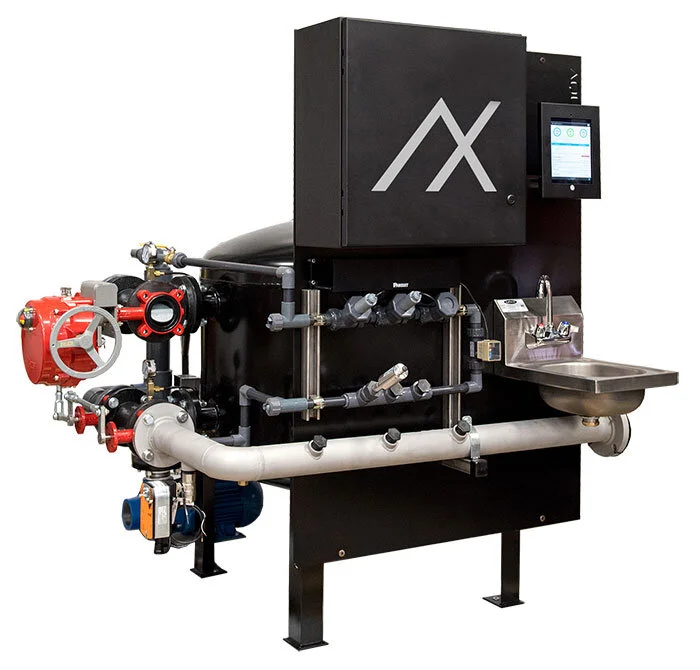
The Cube™ is an IoT-enabled, all-in-one water management system designed to optimize building heating and cooling performance by continuously managing water quality.
Air and water introduce impurities that drive higher energy use, excess water consumption, and premature equipment wear if left unmanaged. The Cube™ aggregates real-time water system data into a single patented performance benchmark—the Nexus Number™—giving facility teams remote visibility to make faster, smarter decisions that improve water health while reducing energy and operating costs.
The system addresses the four primary risks to water system performance—corrosion, biofouling, scale, and suspended solids. Suspended solids are continuously removed through high-efficiency filtration down to five microns, while corrosion, biofouling, and scale are controlled through data-driven chemistry management powered by the Symphony™ software platform.
The Cube™ hardware integrates filtration, chemical injection ports, a blowdown valve and meter, and a multi-sensor suite into a centralized solution, enabling real-time monitoring, proactive risk mitigation, and measurable efficiency gains across cooling and heating assets.
Cube™ Hardware
The Cube water management architecture provides your pathway to hydro-intelligence through these key features:
Factory piped and tested water treatment station
Enhanced water quality sensors, including the Canary sensor detecting biofilm down to a monolayer
30% reduction in real estate footprint
High quality, industrial grade components
Industrial grade skid with plug-n-play installation
Quick ship program

CASE STUDY
The CUBE in Action: Quantifying a 115% Impact on Chiller Efficiency
In a real-world case study, a large commercial chiller plant experienced a 115% increase in energy consumption per ton of cooling when side-stream filtration was offline—despite similar weather and occupancy conditions. Download the white paper to see the statistically validated data showing why effective filtration isn’t optional infrastructure, but a critical driver of energy efficiency and operating cost control.